


July 21, 2024

Strawberry fields of Farakka: A new dawn

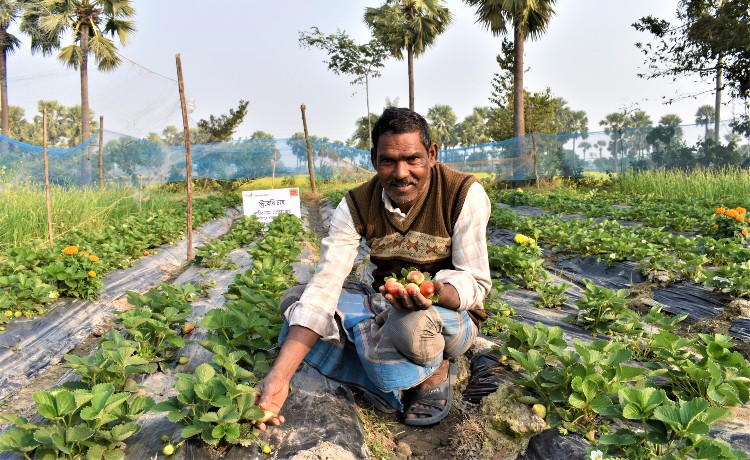
In Abhla, Lakhipur, and other neighbouring villages in Farakka, an unfamiliar fruit brings hope and higher income. A strawberry called Winter Dawn.


In this socio-economically backward region of Farakka in Murshidabad district, West Bengal, most marginal farmers and sharecroppers work on plots averaging less than 1.5 hectares. (1 acre)


Cultivation was traditionally monsoon-dependant, yielding only a kharif crop. Here at the juncture of the Chhota Nagpur Plateau and the Gangetic Plain, farmlands are often at a higher level from the river that flows not too far away. Irrigation is a challenge.


To address the irrigation problem in Farakka, Ambuja Foundation encouraged farmers to adopt the River Lift Irrigation (RLI) system. Designed to pull water up to a height from a river, it enables irrigation and is transformative. RLI increases overall productivity and makes two, even three crops possible.


In search of a high value crop


Now that water was available, Ambuja Foundation – a firm believer in doubling farmers’ income – decided to explore high market value crops in areas where it was feasible to grow them. In the upland farms, farmers were urged to consider more profitable produce for the rabi season. That’s how strawberries first came to the fields of Farakka.


As India prospers, a taste for more exotic and expensive food is burgeoning. Dragon fruit, chia seeds, avocado… the Indian table is experimenting and open. However, farming communities in many parts of the country, certainly Farakka, have no prior knowledge of these crops. They are also hesitant to try something new.


Ambuja Foundation’s intervention aimed to help farmers step out of their comfort zone and truly impact earnings.


Strawberries had potential and would multiply income. But the fruit grows in cool climes. How would you grow it in farms where temperatures shoot up to 35 degrees Celsius after February? Ambuja Foundation in consultation with the Krishi Vigyan Kendra, identified the Winter Dawn variety which could be cultivated here. Farmers were given training, they also had to participate by contributing 50 percent of the cost of saplings, which was sourced from Maharashtra.


First steps with strawberries


However, not many farmers were convinced. Finally, in 2020, four small farmers agreed to plant strawberries in demonstration plots. Production was satisfactory, but the fruit is highly perishable, so Ambuja Foundation sourced packaging to support the endeavor. That year, the farmers realized a profit of Rs 200 (per kilogram). What they really enjoyed was the fact that from only 0.33 acre and in just about four months, they could realize such gains.


Winter Dawn takes root


The attractive profits and short investment period are paying off. Now almost 40 farmers have started cultivating Winter Dawn.


In Abhla village, Tetra Roy owns a 1-acre farm. In 2021, he grew the usual kharif crop of paddy and grass peas. Then for the rabi season, he opted for mostly mustard and potato, planting strawberries in a tiny corner of 0.03 acres. The strawberry output was 2.80 quintals, he earned Rs. 42,000 from it. His total income went up threefold from around Rs 40,000, in 2020 to Rs 1,40,000 in 2021, with almost 30% of it coming from strawberries.


There are even four or five women famers, “Didis”, growing strawberries now. In Farakka, Many women live without their husbands who are migrant labour. Before, the women worked at the hot, backbreaking brick kilns nearby. They earn much more from strawberries, without having to toil so hard. In Lakhipur, Srimati Mandal’s 0.33 acre yielded a first strawberry crop of 10.50 quintals and a net profit of Rs. 1,05,000. She plans to invest her earnings in the coming season’s cultivation and buy more land to produce high value crops.


This year, farmers saw up to 10 quintals of strawberry production from 0.33 acre. They are reporting almost Rs. 1.5 lakh in profit alone. Ambuja Foundation continues to support the farmers from farm to market. Next on the cards is teaching sapling production and establishing a nursery nearby. Ambuja Foundation is also working on minimizing wastage when temperatures suddenly rise.


Thanks to the luscious, red fruit that was quite unknown here until recently, lives are changing, incomes are rising, more children are going to school, and winter promises a new dawn.
July 21, 2024

RELATED POSTS
  • Farmers Prosper in Thach, Darlaghat
    February 13, 2017
    Farmers in Thach Village have seen an increase in annual income of between Rs. 20,000-50,000, thanks to the construction of a 52500 litre capacity water storage tank for collection of natural water, along with irrigation channels - benefiting 12 households and 1.5 hac of land.
  • Humans of Ambuja - Veerpal Kaur
    October 08, 2017
    My mother married me off just before I was to appear for my tenth grade exams. And marriage was more of a shock than a joyful experience for me.
  • 25 Year Celebrations at Ambujanagar, Gujarat
    January 04, 2018
    A grand celebration was held to commemorate the 25th Anniversary of Ambuja Foundation at Ambujanagar, Gujarat (where Ambuja Foundation began its journey back in 1993) on 18th December 2017 – the first of many celebrations around the country.
  • Humans of Ambuja - Ogadhbhai Dodiya
    January 04, 2018
    Today, Oghadbai K Dodiya is an important person in his village. Not only is he a forester in the Government Forest Department, but he gained additional trust and reputation when he helped solve the drinking water crisis in Dhamlej - his village.
  • Platform to Boost Sustainable Production & Market Linkages
    January 04, 2018
    In order to promote partnerships and collaboration, Ambuja Foundation has been creating platforms for brainstorming ideas and devising solutions to realise rural prosperity. One such event was a participatory dialogue '<b>Creating Synergies on Sustainable Production and Marketing Linkages</b>' held in New Delhi on 23<sup>rd</sup> November 2017.
An Opportunity to Support
SUBSCRIBE TO OUR NEWSLETTER & BLOGS
Stay updated on the latest insights from Ambuja Foundation.
GET CONNECTED

Strawberry fields of Farakka: A new dawn

In Abhla, Lakhipur, and other neighbouring villages in Farakka, an unfamiliar fruit brings hope and higher income. A strawberry called Winter Dawn.


In this socio-economically backward region of Farakka in Murshidabad district, West Bengal, most marginal farmers and sharecroppers work on plots averaging less than 1.5 hectares. (1 acre)


Cultivation was traditionally monsoon-dependant, yielding only a kharif crop. Here at the juncture of the Chhota Nagpur Plateau and the Gangetic Plain, farmlands are often at a higher level from the river that flows not too far away. Irrigation is a challenge.


To address the irrigation problem in Farakka, Ambuja Foundation encouraged farmers to adopt the River Lift Irrigation (RLI) system. Designed to pull water up to a height from a river, it enables irrigation and is transformative. RLI increases overall productivity and makes two, even three crops possible.


In search of a high value crop


Now that water was available, Ambuja Foundation – a firm believer in doubling farmers’ income – decided to explore high market value crops in areas where it was feasible to grow them. In the upland farms, farmers were urged to consider more profitable produce for the rabi season. That’s how strawberries first came to the fields of Farakka.


As India prospers, a taste for more exotic and expensive food is burgeoning. Dragon fruit, chia seeds, avocado… the Indian table is experimenting and open. However, farming communities in many parts of the country, certainly Farakka, have no prior knowledge of these crops. They are also hesitant to try something new.


Ambuja Foundation’s intervention aimed to help farmers step out of their comfort zone and truly impact earnings.


Strawberries had potential and would multiply income. But the fruit grows in cool climes. How would you grow it in farms where temperatures shoot up to 35 degrees Celsius after February? Ambuja Foundation in consultation with the Krishi Vigyan Kendra, identified the Winter Dawn variety which could be cultivated here. Farmers were given training, they also had to participate by contributing 50 percent of the cost of saplings, which was sourced from Maharashtra.


First steps with strawberries


However, not many farmers were convinced. Finally, in 2020, four small farmers agreed to plant strawberries in demonstration plots. Production was satisfactory, but the fruit is highly perishable, so Ambuja Foundation sourced packaging to support the endeavor. That year, the farmers realized a profit of Rs 200 (per kilogram). What they really enjoyed was the fact that from only 0.33 acre and in just about four months, they could realize such gains.


Winter Dawn takes root


The attractive profits and short investment period are paying off. Now almost 40 farmers have started cultivating Winter Dawn.


In Abhla village, Tetra Roy owns a 1-acre farm. In 2021, he grew the usual kharif crop of paddy and grass peas. Then for the rabi season, he opted for mostly mustard and potato, planting strawberries in a tiny corner of 0.03 acres. The strawberry output was 2.80 quintals, he earned Rs. 42,000 from it. His total income went up threefold from around Rs 40,000, in 2020 to Rs 1,40,000 in 2021, with almost 30% of it coming from strawberries.


There are even four or five women famers, “Didis”, growing strawberries now. In Farakka, Many women live without their husbands who are migrant labour. Before, the women worked at the hot, backbreaking brick kilns nearby. They earn much more from strawberries, without having to toil so hard. In Lakhipur, Srimati Mandal’s 0.33 acre yielded a first strawberry crop of 10.50 quintals and a net profit of Rs. 1,05,000. She plans to invest her earnings in the coming season’s cultivation and buy more land to produce high value crops.


This year, farmers saw up to 10 quintals of strawberry production from 0.33 acre. They are reporting almost Rs. 1.5 lakh in profit alone. Ambuja Foundation continues to support the farmers from farm to market. Next on the cards is teaching sapling production and establishing a nursery nearby. Ambuja Foundation is also working on minimizing wastage when temperatures suddenly rise.


Thanks to the luscious, red fruit that was quite unknown here until recently, lives are changing, incomes are rising, more children are going to school, and winter promises a new dawn.
LinkedIn Post
Ambuja Foundation