


Increasing the insitutional delivery of babies in Farraka, West Bengal.
A 'neonatal death' is defined as a death during the first 28 days of life and globally, this period carries the highest risk of mortality, per day, than any other period during childhood.
The year was 2014 and in Farakka, West Bengal, the neonatal mortality rate was incredibly high - 43.85 (out of every 1000) compared to a national rate of 28.
The Health team at Ambuja Foundation was disturbed and began to investigate. It turned out that merely 32% of women were having 'institutional deliveries' - the rest birthing at home with local midwives, Dai Maa.
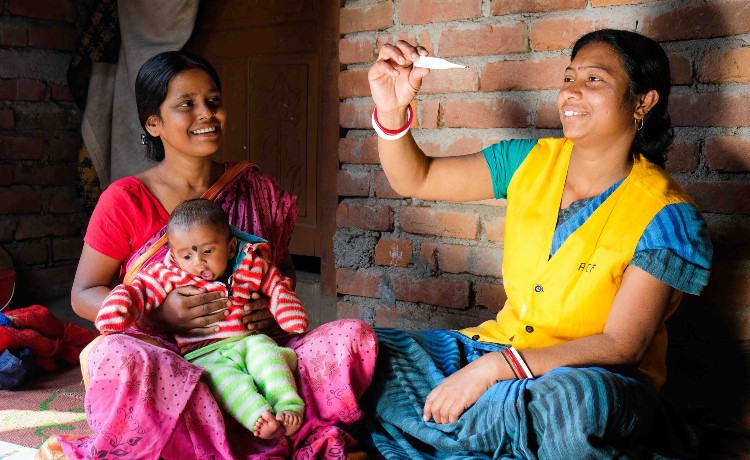
The team decided to promote the benefits of institutional delivery, and better neonatal care. And so the 'Sakhi' program began, with just 10 local women.
The first training took place in 2016 and on completion, the Sakhi was optimistic. But the situation in the field was difficult. In those initial days, they faced many problems - cultural taboos, resistance from husbands/in-laws, and resentment from ASHA's/ANMs.
With so many challenges, one would expect the Sakhi to give up. Instead, they went the extra mile.
'Saira Bibi' convinced a woman having her 5th baby to go for hospital delivery. Despite huge resistance from her husband, Saira put herself on the line. 'Take me to the police if something goes wrong. I take full responsibility.'
One baby was born on the way to the hospital, and the driver turned to go back home. But Sakhi Marang Beti Besra insisted on going to the hospital anyway - to cut the umbilical cord, provide primary care, and ensure both baby and mother were safe.
Slowly the situation turned around, and in just 2.5 years, the institutional delivery rate increased from 28.57 % to 85.07%, Infant Mortality fell from 39.47 to 24.3 and Neonatal Mortality fell from 43.85 to 27.77.
And the proof is in the pudding - lots of healthy, happy babies and mums!