


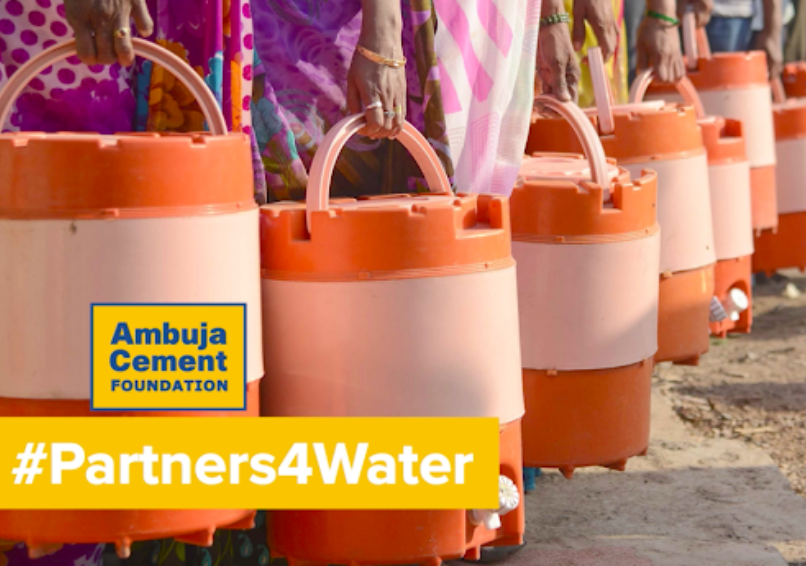
Ambuja Foundation has worked with communities of Chandrapur, Ambujanagar, and Nadi Kudi to install water systems that distribute water equitably, maintaining both quality and quantity. These include RO systems, Water ATMs, and networks of pipes and taps – all owned and managed by the community. During the pandemic, communities ensured water remained accessible for proper sanitation while following social distancing norms.
'A water distribution system transports drinking water from the centralized treatment plant or well supply to consumers’ taps. These systems aim to preserve water quality and quantity and maintain sufficient pressure. They consist of pipes, pumps, valves, storage tanks, reservoirs, and other components.' (Bhardwaj and Metzgar, 2001)
The establishment of Community Led Water Distribution Systems in rural communities (often within 500m of households) is a key programme of Ambuja Foundation which has helped solve the drinking water issues in communities around Chandrapur (Mahrashtra), Ambujanagar (Gujarat) and Nadikudi (Andhra Pradesh) - interventions that have helped empower them during the COVID-19 pandemic. These systems include an RO Water Purifying system in Andhra Pradesh, a RO water purifying and Water ATM in Chandrapur and a Drinking Water Distribution pipeline in Ambujanagar all owned by the communities.
Here below are some of the stories of transformation from Ambuja Foundation owned to community ownership:
Reverse Osmosis Water Purifying System & Water ATM – Nadi Kudi, Andhra Pradesh
When Ambuja Foundation entered the villages of Nadi Kudi, Andhra Pradesh, the lack of safe drinking water was a significant problem - with high TDS contents, and other chemical, biological pollutants in the ground water. As a result, more than 50% of people in the villages were suffering frequently from 'Arthritis', 'Typhoid' and other water borne diseases. Ambuja Foundation showed the water analysis reports and explained the consequences of consuming the poor quality water to the community, to help educate them about the issue.
Brainstorming solutions, it was agreed that the installment of an RO water plant was the best choice to address the issue of purified drinking water. A well-planned distribution system was needed to ensure every household received the water supply equally. But if people wanted the benefits, Ambuja Foundation insisted that they should contribute and invest in the service.
Villagers welcomed the idea of 'RO plant establishment' but were hesitant about coming up with the community contribution. However, after continuous consultations between Ambuja Foundation and the Gram Panchayat, village elders, cooperatives, Women's SHGs and community heads, people began coming forward to contribute:
- The women were the first to come forward with their contributions. They could see the benefits of water reaching their homes, which would reduce the drudgery faced by them and their children. 15 SHGs contributed Rs. 30,000 and a women's federation contributed Rs. 4000 to build a 500 LpH RO plant machinery.
- A Community member and the local Panchayat donated land to build the RO systems on.
- The local Milk Association contributed Rs. 2 lakhs for the construction of the building.
As a consequence 4 RO plants were installed in Budavada village in 2010.Cumulatively, a total of 19 RO plants were set up in project villages of Chandrapur, Maharashtra and Sankrail, West Bengal. As on March 2020, about 4600 households got drinking water and on an average 65,000 litre per day were supplied from these RO systems. All these systems are managed by the community through Village Development Committees/RO Committees. In fact, in some villages women committees are managing these systems. Ambuja Foundation has provided additional training to the committee members on leadership and accounting.
Network of Distribution Pipes & Taps – Ambujanagar, Gujarat
Ambuja Foundation developed a network of pipelines to deliver drinking water directly to households. In 2018, they completed a scheme in Vadnagar covering 1,245 households, eventually extending facilities to 13 core villages.
In Singsar village, a large population caused scarcity. The foundation dug a new well 1.5 km away and connected it to households, ensuring year-round water availability.
Management was handed to Paani Samiti (Water Committee), which collects charges and appoints a water operator. TDS is checked monthly (typically 100–350 ppm). Today, 13 villages benefit from doorstep water supply, supported by 77 committee members.
How do we sustain community ownership?
Ambuja Foundation builds people’s institutions to own and sustain water systems:
- Women SHG Federations: Well-organized groups that understand sustainable interventions easily.
- Water User Associations: Plan repairs and ensure water availability before drought, pooling human and financial resources.
- Village Development Committees (VDC): Manage RO plants and distribution, hire operators, maintain financial records verified regularly by the foundation. Water is sold at Rs. 3–5 per 20 litres via coupons or cash-and-carry systems.
Ambuja Foundation also conducts workshops on TDS testing, RO maintenance, and Water ATM usage to ensure safe water supply.
To know more about these systems and distribution channels, contact: brajeshsingh.tomar.ext@ambujafoundation.com