


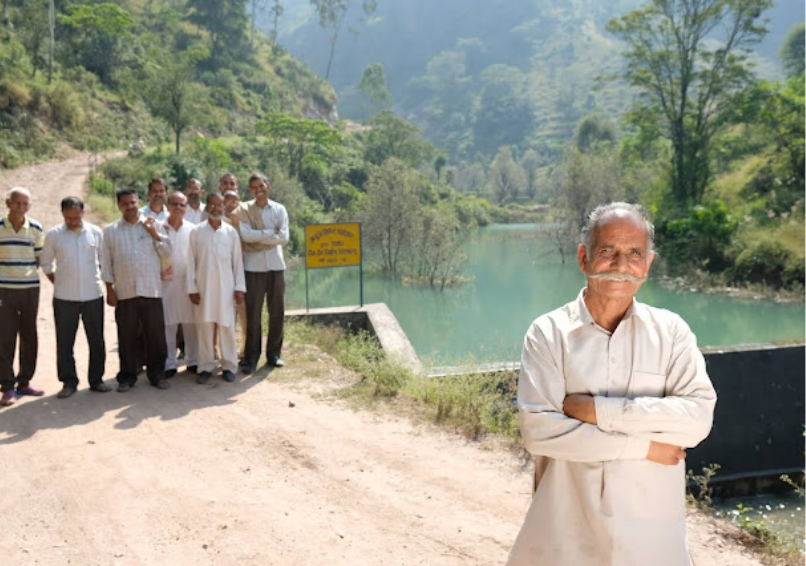
According to an independent social impact measurement study, Ambuja Foundation's Daseran watershed project in Darlaghat has delivered a Social Return on Investment of Rs 8.44 for every Rs 1 invested.
Implemented by Ambuja Foundation and funded by NABARD, the watershed project sought to address multiple challenges being faced by farmers and communities in the area due to erratic rainfall and limited water harvesting structures, which was adversely affecting both households and agricultural activities in the area - thus inhibiting overall prosperity.
Watershed development leads to the conservation, regeneration, and judicious use of human and natural resources (land, water, plants, animals) within a particular watershed. It attempts to reach a balance in the environment between natural resources on one side, and man and grazing animals on the other. It takes people's participation because conservation is possible only through the whole-hearted involvement of the entire community.
Watershed development is important because there are a variety of consequences to deforestation, wrong farming techniques, livestock over-grazing and faulty land use - which lead to the destruction of plant and tree cover, exposing the earth to natural forces like heavy rains, direct sunshine and high velocity winds. This can lead to soil erosion, floods, or water scarcity. Further, agricultural yields are lowered, resulting in a decline in the income levels of the community, and eventually leading to migration of labour from rural to urban areas in search of livelihood.
After the Ambuja Foundation and NABARD collaborative intervention, today, when Solan receives 600 to 900 mm, the new water structures capture and conserve rainwater - making it available for both agricultural and drinking purposes.
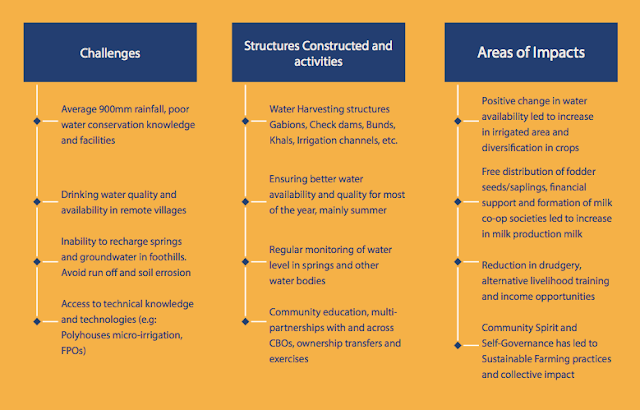
The SROI assessment was conducted to understand the broader socio-economic value creation of these watershed activities across the 18 villages in Kunihar block of Solan District, Himachal Pradesh - with positive impacts seen in the areas of agriculture, dairy, health and overall societal well-being.
- Examples of positive outcomes include:
- Increase in agricultural income and production;
- Increase in availability/irrigation of agricultural land;
- Income change in the sale of milk and milk products (butter, curd, paneer) among farmers;
- Increase in dairy production;
- Farmers' credit limit increased from Rs. 1L to Rs. 3L;
- Farmer Producer Companies availed seeds at cheaper rates - savings of 30-40%;
- Tap connectivity and pipelines reduced the drudgery of women and children in fetching water;
- Water quality improved and was well maintained;
- Increase in community spirit;
- Increase in drip irrigation, mulching and fencing - boosting production by 40%;
Conducted by Sustainable Square, the study utilised the Social Value International SROI framework, which is standardized by the United Kingdom's SROI Network. It is the leading and most advanced framework for social impact measurement, by valuing financial outcomes from non-financial impetus.
Central to the SROI methodology is the monetisation of outcomes in order that they can be measured in a consistent way using a common currency. This of course allows computation of a ratio of benefits to costs as the measure of impact which, expressed in monetary terms, can be set against the initial financial investment.
The process of monetising the relevant outcomes involves identifying financial proxies for each separate outcome. The SROI ratio is calculated by dividing the total present value by the investment.
Additionally, the goodwill and credibility built by Ambuja Foundation through this project helped pave the way to launch agricultural and livelihood programs with minimal community outreach and mobilisation costs.

Anagha Mahajani
General Manager, Program Research & Monitoring, Ambuja Foundation