


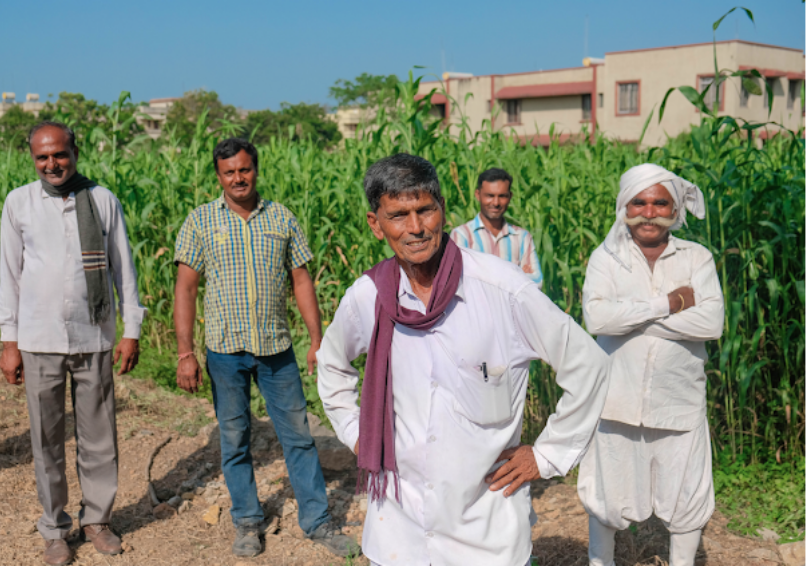
With a proven strength in mobilizing and building the capacity of farmers, it was a natural fit when the Indian Council of Agriculture Research (ICAR), on the lookout for a partner to operate the Krishi Vigyan Kendra (KVK) in Kodinar, Gujarat, commissioned Ambuja Foundation to take up the mantle.
The purpose of KVK is to build capacities of farming communities through training, demonstrations and on-farm testing so as to reduce time lag in technology transfer. With the closest Agricultural University located 110 km away, in Junagadh, the prospect of having a KVK this far away presented a challenge to farmers from Kodinar who would be unable to access training if the KVK was established there.
Ambuja Foundation put its hand up for the job, and Ambuja Cements Ltd agreed to provide 20ha of land for the establishment of a KVK at Ambujanagar. After a rigorous due diligence process and assessment, ICAR sanctioned the KVK in 2007-08, to be operated by Ambuja Foundation for the district of Junagadh.
Ambuja Foundation's KVK team followed a participatory approach to plan interventions after careful consultation with farming communities. They started by selecting 18 villages in six blocks (Kodinar, Sutrapada, Talala, Girgadhada, Veraval and Una) to understand the agriculture situation and identify the gaps in knowledge, skills and adoption of technologies. Based on this, baseline information was generated and inputs were planned to plug the gaps by organizing training, demonstrations and activities.
So far KVK inputs are reaching 313 villages of Junagadh and Gir Somnath districts, and over the last 11 years, Ambuja Foundation has been able to reach and educate farmers, via a number of interventions including:
| Activities | Number Held | Participants Reached | Remarks |
|---|---|---|---|
| Capacity Building through Training | 1416 | 42062 | Farmer/ Farm women / Extension functionaries / Rural youth |
| Front Line Demonstration | 220 | 3830 | Introduced new varieties of five crops in the area. Also demonstrated IPM/IDM/INM & animal husbandry and transferred 72 technologies for farmers adoption |
| On-Farm Testing | 24 | 176 | Assessed/ refined the research technologies at farms as per identified problems in the district |
| Other events - Field Day / Technology Week / Krishi Mahotsav etc | 18,528 | For farmer-scientist interactions/visit to address specific agricultural issues/problems and display of different technologies to optimize the cost of cultivation for the farming community | |
| Extension Literature / Articles | 69 | 74,500 copies | Updated reading material for farmers to use as agri knowledge |
- FM Community Radio Station - In November 2013, an FM community radio station was started to bridge the information-knowledge gaps of the farming community in the locality with the latest and relevant information. The Lokvani Radio station, today, covers 54 villages in the surrounding 12-15 Km radius of KVK premises.
- Promotion of Organic Inputs: KVK promotes the use of organic fertilizers as well as biofertilizers. Information about the use and benefits of organic inputs is emphasized in every activity undertaken. KVK provides training on how to prepare organic fertilizers through vermicomposting and the NADEP method of composting from farm waste. KVK also provides bio-fertilizers, bio fungicides and bio-pesticides to farmers.
- Museum (Display of Different Agricultural Technologies): KVK has developed a techno museum to showcase agricultural technologies in the district.
- Crop Cafeteria: KVK has initiated a crop cafeteria for demonstrating all crop varieties that can grow in the prevailing agroclimatic conditions for farmers by employing the concept of 'learning by seeing'.
- Soil, Water & Leaf Testing laboratory: A Soil and Water Testing Laboratory was established at KVK to provide knowledge about soil and water conditions at farms, by analyzing different soil & water parameters and making recommendations accordingly to the farmers. Additionally, a laboratory to ascertain the different macronutrient deficiencies in standing crops has been established - enabling the team to recommend remedial measures according to the deficiency.
- Model Nursery unit: The district has enough potential to grow fruit plants and vegetables. To meet the demand of improved vegetable seedling/sampling the KVK has initiated a horticulture nursery with a poly house and net that provides 80,000 improved quality vegetable sapling/ seedlings annually.
- Fish Pond Unit: For the fishermen community, the KVK has started a Fish Pond unit to promote freshwater fishing of fish like Rohu, Catla, Mrigal and Prawns.
- Farm Machinery Unit: KVK lays a strong emphasis on the mechanization of agriculture. The Farm Machinery unit was established to apprise the farming community about new farm implements as well as tools.
- Organic Mango Orchard: The district is well known for Kesar Mango orchards. To effect a better quality of production for farmers, KVK setup a 1000 Kesar Mango trees plantation on its premises that is being nurtured without any use of chemicals.
- Nutritional Kitchen Garden Unit: KVK also developed a nutritional kitchen garden unit for demonstration cum advertisement of different seasonal major vegetables in rural farms.
- Medicinal Plants Unit: 70 medicinal plants were introduced in a demonstration unit for providing medicinal value to improve the health of the animals and farming community.
- Agriculture Inputs Mall: This was set up by KVK as per the need of the farming community to ensure better, cheaper agricultural inputs including bio-fertilizers, bio-pesticides and other bio-agents.
- Technology Information Unit: KVK initiated this unit with a "voice message service" that sends out 45-50 messages, annually to about 8000 farmers. The messages include information about different agricultural issues as per season & crop like ICM, INM, IPM, IDM and also on animal husbandry etc. A "touch screen kiosk" was also established to build knowledge of farmers.
- Azolla Unit: KVK also started a demonstration unit in Azolla to use protein-rich cattle feed for farmers of the district.
- Bio-Digester Unit: This unit has been started to develop biopesticides from locally available weeds using low-cost technology.
- Cattle Feed Unit: This unit has been in operation since January 2018 through an FPO, promoted by KVK-Ambuja Foundation to provide qualitative cattle feed for about 300 livestock keepers on a monthly basis with a per day capacity of production of 2 Tons and consumption of 1.6 Tons.
As a result of efforts by KVK, farmers have adopted new technologies, become entrepreneurs and increased their income, with many receiving awards at university, district and state levels.