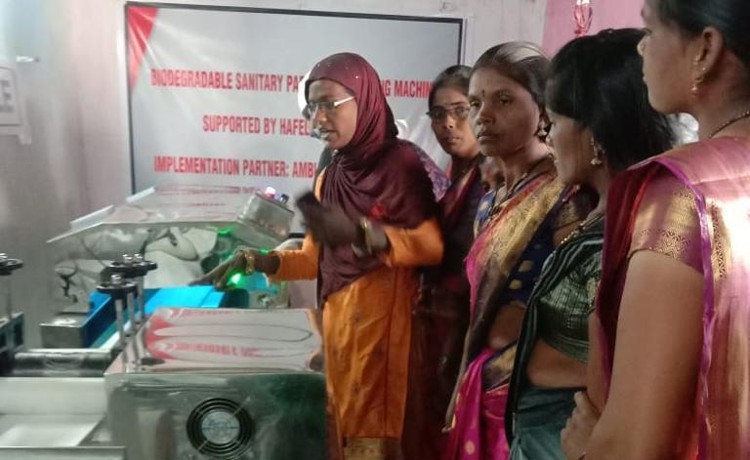
The spare room in Mehra Sheikh’s house has been transformed. It’s become a sanitary pad production centre and it bustles from day to night as women come and go, meeting strict production targets for the new menstrual hygiene product.
It’s the ‘nerve centre’ of a new SHG run micro enterprise in Chandrapur, which is seeing women tackle the issue of menstrual hygiene, and generate an income in the process.
Promoted by the Ekta Women’s Federation, who source raw material and trains women in the project, the enterprise is not only educating women on the importance of menstrual hygiene, but is filling a ‘gap’ in the market for affordable ‘gel based pads’ that women, who work long days in fields, want and are also biodegradable and environment friendly.
It’s an important, albeit ‘taboo’ topic, as many women in India continue to use unsafe methods of protection during menstruation, such as un-sanitized waste cloth or ‘make-shift’ pads stuffed with sand, ash, or husk - resulting in a variety of health problems, including reproductive and urinary tract infections.

On a positive note, the proportion of women, aged 15-24 years, who use hygienic methods of protection during their menstrual period in rural areas (locally prepared napkins, sanitary napkins, tampons and menstrual cups), increased from 48.2% in 2015-16 to 72.3% in 2019-21. [MOU1]
But there is still a long way to go to address this important ‘preventive healthcare’ issue. Preventive healthcare measures, such as using hygienic methods of protection during menstruation and sanitation, help avoid the spread of diseases.
In its nascent stages, the project is just one of 4 sanitary pad micro enterprises initiated by Ambuja Foundation promoted Women’s Federations. Women in Kodinar, Daraghat and Chattisgarh are also busy with sanitary pad production and an army of women (all federation members) are being groomed as ‘marketing agents’ to act as supply chain linkages by selling the product as well as educate women and girls in the process.
Marketing agents too will benefit, earning 2 rupees per sale and knowing they are supporting ‘their own’ in a home based enterprise. They conduct group meetings, distribute IEC materials and have also created digital whatsapp groups with women and school adolescents creating awareness and in turn generating sale of the Sanitary pads.
With dual benefits for women and girls, the sanitary pad production project has great potential to not only transform engrained beliefs and practices of women (and families) when it comes to menstruation and the use of ‘cloth’ every month.
Mehra Sheikh, the leader of Sampada SHG and mother of two, was prompted to get involved when her daughter suffered rashes and other discomfort from improper menstrual hygiene – she wanted to do something to change that for other girls.
From a strict muslim family, she faced many challenges as generations-old practices had to be broken. But today she has the full support of her family – so much so that her house has become the production centre of the enterprise, which is driven by 4 women from her SHG.

It is just the beginning for these women, but a great model to both educate women and economically empower them at the same time – we wish them every success in their journey.
*https://www.indiaspend.com/data-viz/more-women-used-menstrual-hygiene-products-in-rural-india-in-2019-21-794511