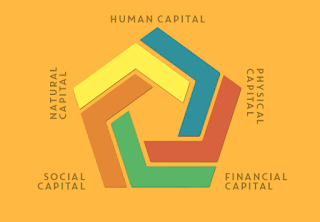
One of our earliest learnings at Ambuja Foundation, was that to tackle poverty in rural India, we needed to build the livelihood capabilities of rural people. Sounds simple, right? In fact, it's not! For livelihoods is a multi-faceted issue and is so much more than just the impart of skills and education. We saw first-hand the many areas of a person's life that impacted their ability to earn a livelihood, and recognised that we would need to take a more multi-dimensional approach to the problem. And so we adopted the Sustainable Livelihoods Approach to our work.
The Sustainable Livelihoods Framework
Rather than approaching poverty simply as a lack of income, the sustainable livelihoods approach considers the assets that poor people need in order to sustain an adequate income to live. The more assets any household has access to, the less vulnerable they will be to negative effects of shocks (conflict, illnesses, floods, storms, droughts, pests and diseases) and, the more secure their livelihood will be.
So what are these 'capitals and how do they affect the livelihoods of rural families?
• Human Capital - includes health, nutrition, education, knowledge, skills and capacity to work. Whilst education and skill training are key assets, people also need to be in good health - poor health adds an enormous economic burden for the poor, diminishing their capacity to work.
• Social Capital - includes networks and connections, relations of trust, mutual understanding and support, formal and informal groups, collective representation, mechanisms for participation in decision-making, and leadership. A key asset that rural India lacks are networks and co-operatives, without which the rural poor have no bargaining power or voice, leaving them feeling disempowered. This is particularly true for women and other marginalised groups.
• Natural Capital - includes land and produce, water and aquatic resources, trees and forest products, wildlife, biodiversity, and environmental services. Natural capital impacts rural communities in myriad ways. For instance, the lack of potable water is an enormous opportunity cost for the empowerment of women, who disproportionately bear the burdens of fetching water, collecting firewood and other domestic responsibilities. This severely impacts their physical security, opportunities for adult education, overall productivity, income-generating capacity, nutritional status, time and overall health and well-being. A big threat to our natural capital is Climate Change - as climate changes, droughts, floods and pest attacks intensify or alter, often with severe consequences, causing huge losses rural households.
• Physical Capital - includes infrastructure (transport, roads, vehicles, secure shelter and buildings, water supply and sanitation, energy, communications), tools and technology (tools and equipment for production, seed, fertilizer, pesticides, traditional technology). The poor need access to communications, power supply and many other such infrastructure aspects, in the absence of which building any livelihood would be impossible.
• Financial Capital - includes savings, credit and debt (formal, informal), insurance, wages. In the context of rural India, awareness of the various government schemes and access to them are key, and farmers need access to institutional credit, crop insurance, access to markets and even access to new techniques of improving productivity are essential to building sustainable livelihoods.
Often increasing one type of capital will lead to an increase in other amounts of capital, thus there is a need to work on a variety of capitals at once as they are interdependent and results in one area will catalyse results in another area. For example, as people become educated (increase in human capital) they may get a better job which earns more money (increase in financial capital) which in turn means that they are able to upgrade their home and facilities (increase in physical capital)[1]). However if their health is affected, it undermines their ability to earn.
The sustainable livelihoods approach is just one of the ways of organizing the complex issues that surround poverty, but it does encourage us to think out of the box. Most importantly, it compels us to take a multi-dimensional view of livelihoods, understand the need for multiple entry points into a community and to move beyond a one-dimensional or narrow approach to rural development.
Ambuja Foundation's 6 key thrust areas - water, skills, agriculture, health, women and education, are designed to support rural Indians in enhancing their livelihoods so that they can prosper in life.
[1] SOAS, UK