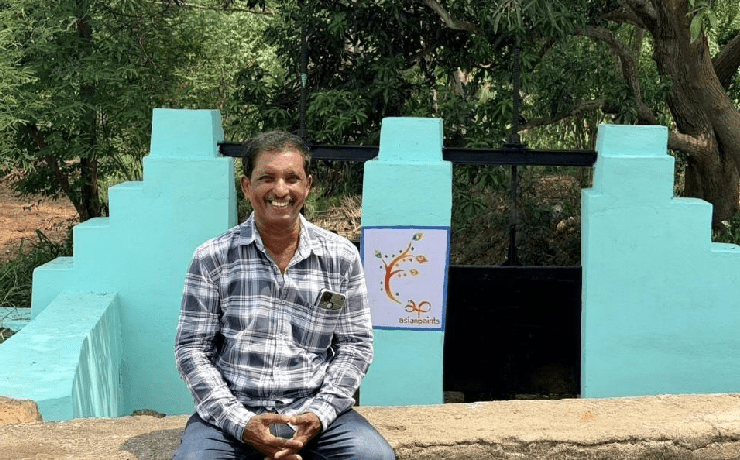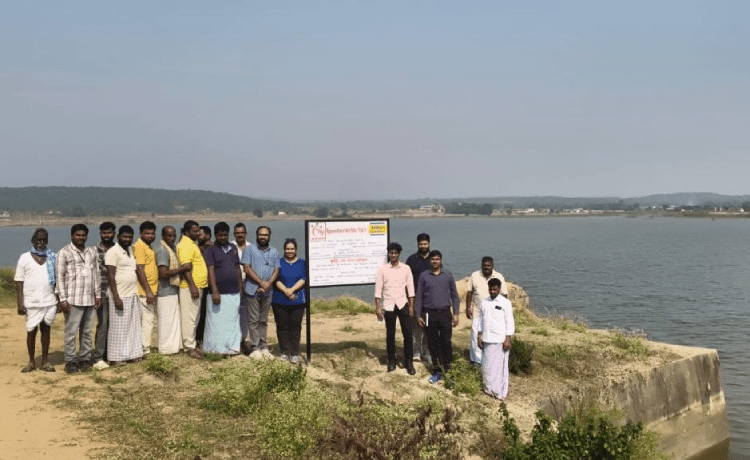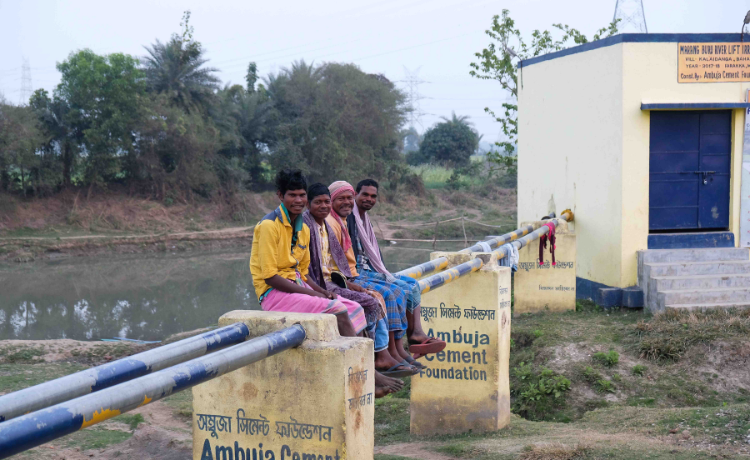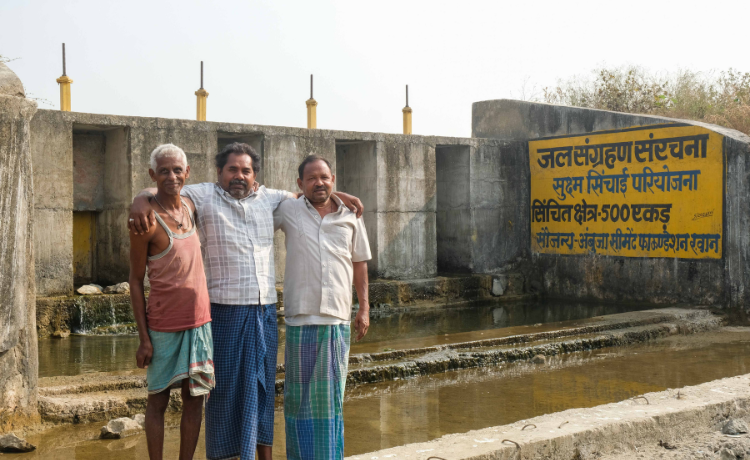

Across Ambuja Foundation locations, a cadre of ‘Water Volunteers’ is the quiet, driving force behind access to water in communities – for both drinking water and livelihood purposes. Playing diverse roles, from monitoring water quality, to operating irrigation pumps, these water champions work long hard hours – for free – to ensure water is available when people need it. Who are they? And what drives these selfless heroes?
Shounathan Mandal, a farmer from Farakka in West Bengal, has been an Ambuja Foundation Water Volunteer since 2020 - enabling Ambuja Foundation's ambitious vision of helping to build drought-resilient villages. In addition to farming his own land, Shounathan manages the pump, as part of a new River Lift Irrigation (RLI) system. His responsibilities include delivering irrigation water to farmers, operating the pump, maintaining crop intensity records, working with water user groups, conducting system trainings and discussions, and overseeing the technicalities of pipeline fitting and fixing.
But it’s only when you take a look at his typical day that you begin to understand and appreciate the enormity of his role. When farmers request water, Shounathan mobilises into action – in peak season, his pumping responsibilities can extend up to 10-12 hours at a stretch, and occasionally, two outlets are utilised, so the pumping continues until 12 o'clock at night! This is the extent of his commitment. At such times, it’s his wife who keeps his own farm operation going in the meantime – so in fact, it’s a team effort!
Prior to this, his village lacked irrigation infrastructure – despite the fact that the mighty Kalnai river was just yards away, they were unable to access it’s abundant water, for want of a pump. Farmers were hand to mouth, and as small, marginal, tribal farmers, poverty was rampant. By providing water through an RLI whenever needed, farmers and cultivators are able to stabilise agriculture production, increase food production and boost income levels. Which it has successfully done - prior to the implementation of RLI (River Lift Irrigation) in Farrakka, farmers were only able to cultivate a single crop. However today, these measures have enabled them to cultivate multiple crops.
Of course, these volunteer roles at Ambuja Foundation are not without their own share of challenges. Community mobilization, getting farmers on the same platform and the selection of outlet points in the construction of RLI, are just some of the hurdles that water volunteers, like Shounathan, have faced.
Of course, before any type of irrigation infrastructure could be developed to aid farmers and villages, tremendous community engagement was required. Here, Shounathan stepped to the fore with zeal, and provided all important community linkages to get all farmers together and on board. Presented with a variety of water solutions, the group decided on the development of a River Lift Irrigation system - a method by which water is lifted from a river or irrigation canal using a pump or other mechanical means - and everybody got to work.
But before the RLI systems were constructed, the need of the hour was to define outlet points, which could only be done by large surveys, another area where Ambuja Foundation Water Volunteers played an important role.
After finishing and handing over the entire system to the community, it was the volunteers that were required to run the system. In Farrakka, a total of eight RLI systems were developed, and so today, there are eight water user groups and eight volunteers in this region - all of whom are assisting Ambuja Foundation in the development of drought-reslient communities.
When asked what inspires a farmer to volunteer with an organisation such as the Ambuja Foundation, Shounathan responded, "Because Ambuja Foundation operates at the grassroots level, there is an opportunity to work with other farmers and help them improve their quality of life. The fact that I am able to help provide water to farmers and increase their profitability, puts a smile on my face and keeps me going every day."
Ambuja Foundation has trained and oversee a number of Water Volunteers across locations and this investment in local people as stewards of local water projects has certainly paid off. Our parting observations on these volunteers and their passionate efforts? If agriculture and farming are the backbones of our society, then we need volunteers like Shounathan to help build, fortify and strengthen those backbones.
#AmbujaforWater
Article written by guest writer, Kavita Bhaskaran