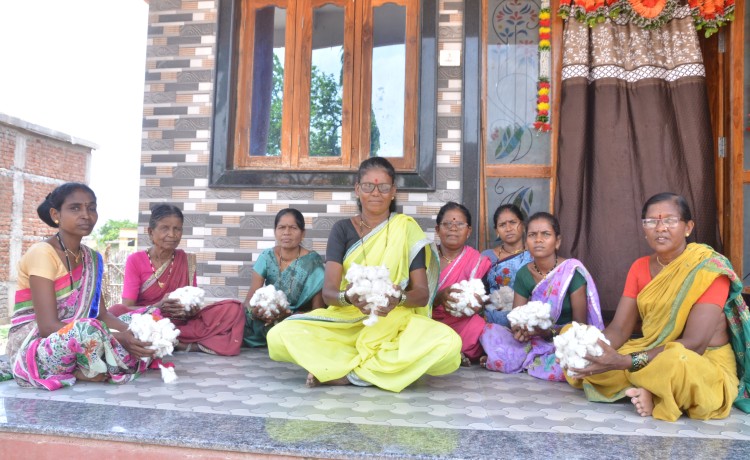



Name : Shraddha, Bhoomi & Nandkishore SHGs
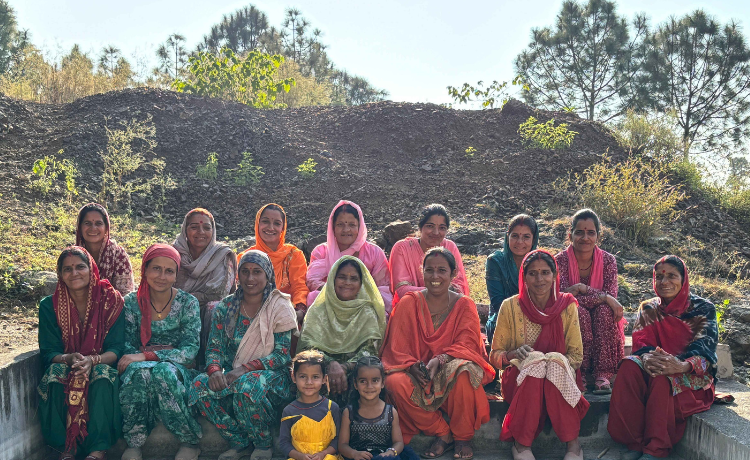
Members : 32 women
Location : Arjuni, Bhatapara, Chhattisgarh
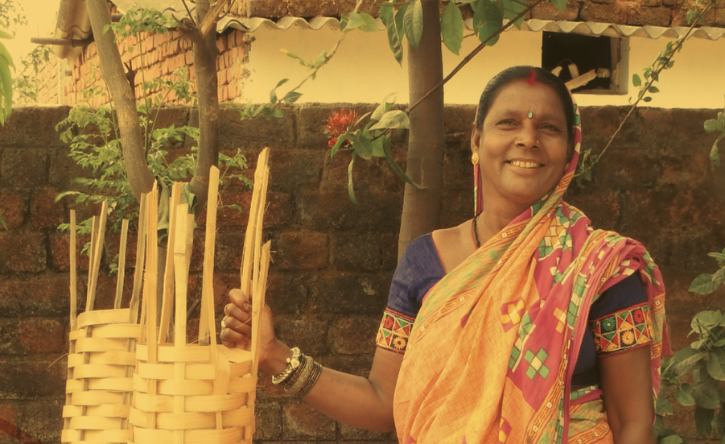
Work : Traditional Bamboo Weaving
Villagers of Arjuni live nestled on the fringes of the Barnawapara forest and are primarily Adivasi tribals – relying on the gifts of the forest for their livelihoods. Here, the primary source of income is found in weaving traditional bamboo products – baskets, brooms, fans and other household utility and decorative items.
But plagued with the onslaught of plastic products in the marketplace, households here were finding it harder and harder to make a sustainable livelihood from this ancient handicraft.
That was until women united to form 3 Self Help Groups (SHGs) and started collectively making tree guards to supply to local panchayats. It all began when the local sarpanch heard of their coming together, and decided to offer an order for 1000 tree guards – to protect saplings that were planted to regenerate trees in the area.
Whilst planting a tree is not a difficult task, keeping it alive as it grows is a challenge – it’s highly vulnerable to animal grazing. With iron or cement tree guards being expensive or easily stolen, local bamboo provided a perfect alternative, that could simultaneously generate income for tribal families in the area.
Buoyed by the contract, the women worked tirelessly to meet the order, and soon word got out of the quality and quantity of the guards, with 3 other panchayats coming forward to place similar orders.
The women’s income went from a mere Rs. 100 per day to Rs. 500 or Rs. 600 – with 50% being kept by the SHG to invest in raw materials for future orders. The lives of the women have been transformed as a result. Each lady proudly has her own bank account, and has become more independent and confident within the family. They have started getting involved in the local community more and have found solace and peer support within the group.
But this unique path has not been without its challenges. The women have faced difficulty sourcing raw materials with private local suppliers charging exorbitant amounts for fresh bamboo.
Fortunately, their SHG status enabled them to source cheaper bamboo from the local Forest Department, helping solve this problem. And with a regular income within the SHG, women have been able to initiate loans, helping solve other problems for members. Pooja Katare contracted typhoid one year and struggled to pay the medical bills – until the SHG came to her rescue. Similarly, Indrani Katare’s husband required an eye operation, and was supported with funds.
The Bamboo Tree Guard business has not only enabled incomes, but has enabled low-cost loans – helping families stay out of the clutches of local loan sharks. Their work has also attracted the attention of the District Collector – with the groups being honoured for their work. And best of all, the dying art form of traditional bamboo weaving has been revived in the area!
Impact
32 Women
3 SHGs
4300 Tree Guard Sold Per Year
Rs. 50-55,000 Additional Income Per Year Per Woman