


Water quality testing plays a critical role in India in ensuring it meets its objectives to provide safe drinking water to every citizen. And today in the times of COVID-19, it plays an even greater role, as poor water quality is proven to be a major factor in reducing immunity levels in people.
Whilst India is grappling with a water crisis that sees communities struggle to access water for basic household and livelihood needs, a secondary issue lurks in the background that threatens the health of villagers across the country. The quality of drinking water is a widely emerging issue — especially in rural areas that depend on groundwater.
Declining water quality has become a national issue of concern with India's growing population, industrial and agricultural expansion, and climate change — causing major alterations to the hydrological cycle. According to Water Aid India*, arsenic affects 45 districts from ten states; fluoride is present in 202 districts and 20 states; nitrate in 141 districts and 21 states; and iron in 258 districts and 24 states. Microbiological contamination also contributes significantly to diarrhoeal diseases.
In Ambujanagar, Kodinar in rural Gujarat, high levels of TDS (Total Dissolved Solids) and salinity were key concerns, leading to health issues like kidney stones, hypertension, and digestive problems. Additionally, waterborne diseases increased during the monsoon. To address this, Ambuja Foundation mobilised to help communities test and monitor their own water quality.
Three-phase program by Ambuja Foundation
Phase 1 – Awareness
Ambuja Foundation launched awareness campaigns, placing large posters in village common areas explaining TDS levels, permissible limits, and effects on health. A vehicle was also hired to make announcements about the health risks of poor-quality water.
Phase 2 – Testing
Ambuja Foundation purchased H2S Vial bottles and bacteria drips for testing. Collected water samples were kept at room temperature for 24 hours; turning black indicated bacteria presence. Live demonstrations were organised at common water sources, and bottles were distributed to encourage home testing. Villagers, after seeing results, became proactive in testing more sources.
Phase 3 – Water Treatment
Ambuja Foundation trained communities on practical solutions: how to chlorinate water, measure residual chlorine with chloro-scope metres, and maintain proper proportions. Water Operators were trained to manage treatment at community level.
This participatory model led villagers to regularly clean community tanks and RRWHS structures. For instance, Ram Singh from Thoradi village now collects chlorine tablets periodically to clean his rainwater tank, while Lakhambhai engages volunteers to clean tanks regularly.
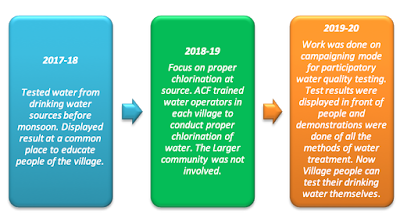
Since launching in 2017, Ambuja Foundation has helped make 13 villages self-reliant in testing and managing their water quality, especially during high-risk periods like peak summer and monsoon.
By taking a participatory approach over the past 27 years, Ambuja Foundation has achieved sustainable, long-term success in many programs — including water quality testing, where communities report fewer health issues.
To have Ambuja Foundation implement a water quality testing campaign in your region, or to know more, contact: brajeshsingh.tomar.ext@ambujafoundation.com
* https://www.wateraidindia.in/blog/why-is-it-critical-to-train-women-on-water-quality
.png)