


Name: Bhundani Village
Title: A Climate Resilient Farming Community
Location: Amreli District, Gujarat
On a once-barren patch of community land in Bhundani, a dense forest is beginning to rise. In just a few years, over 4,500 saplings have been planted here, creating a thriving Miyawaki plantation alive with birds, insects and medicinal plants. It is one of 12 village plantations where 33,000 saplings are helping create a greener future.
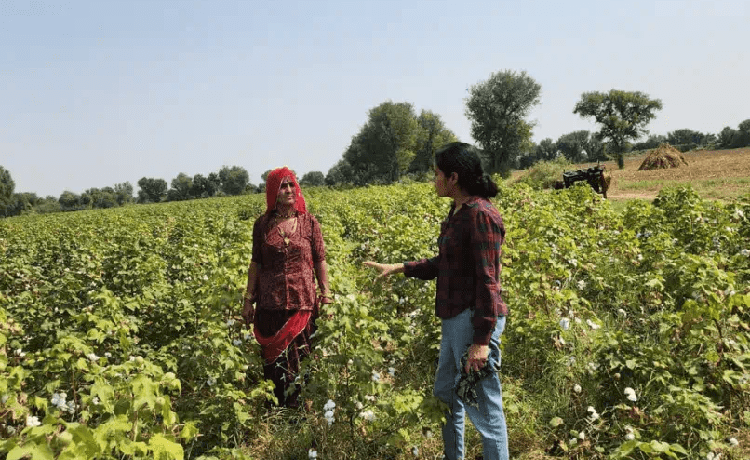
For a village in Gujarat’s rainfed cotton belt, where farming has become increasingly difficult attributed to rising temperatures, water stress, and declining soil health, the sapling forest has become a visible sign of change. And it is only one part of a much larger transformation now underway across Bhundani through Ambuja Foundation and Better Cotton Initiative.
- Rebuilding Ecology Through Miyawaki Plantation
- Resetting Soil Health
- Reimagining Water Security
- Bringing Climate Action into Everyday Life
- Building a Community-Led Climate Model
Climate resilience efforts began with restoring degraded landscapes. Across community land provided by the Panchayat, dense Miyawaki plantations using native species were planted to mimic natural forests. These micro-forests improve soil fertility, retain moisture, reduce heat stress, and attract birds, insects, and pollinators back into the ecosystem. The village also created eco-parks in schools with medicinal and native plants, introducing children to environmental stewardship early on.
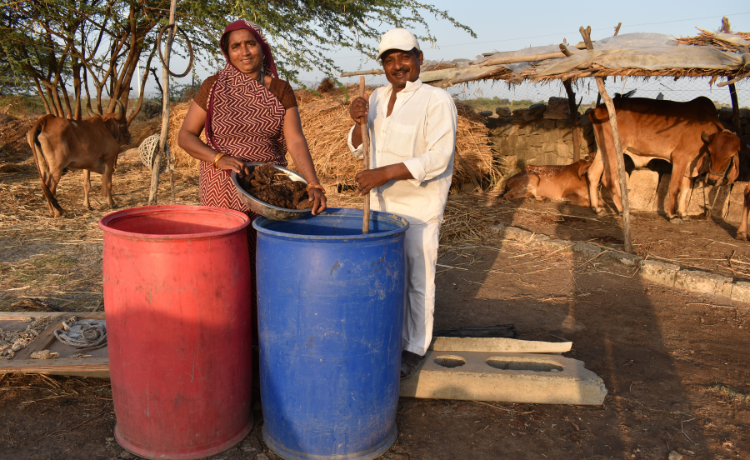
For years, farming in Bhundani depended heavily on chemical fertilisers, pesticides, and cotton monocropping. Soil health weakened, crop residue was burnt after harvest, and moisture retention declined. Farmers gradually adopted Jeevamrut and other bio-inputs, improved crop spacing, and began shredding cotton stalks back into the soil. Fields once dependent only on cotton now also grow groundnut, onion, and millets. The results are measurable: soil organic carbon levels increased from 0.46 to nearly 0.70, steadily restoring soil fertility in many fields.
Water stress had become one of the region’s biggest challenges. In response, Bhundani adopted drip irrigation, alternate-furrow irrigation, pond deepening, and well recharge systems. Two village ponds were also desilted to strengthen groundwater recharge and drought resilience. Across 12 villages, six renovated check dams are improving water storage and irrigation reliability for 165 farming families.
Climate resilience in the project villages extends beyond farming. Families adopted 140 biogas units and nearly 475 solar cookers, reducing dependence on conventional fuels and firewood. Pasture land development has also improved fodder quality for livestock while reducing pressure on surrounding ecosystems.
Perhaps Bhundani’s biggest transformation has been social. What began in 2017 through farmer learner groups and demonstration plots gradually evolved into a culture of experimentation and shared learning. Farmers now exchange bio-inputs, collectively purchase seeds, test new practices together, and encourage one another to adopt climate-resilient farming, step by step.
Today, Bhundani forms part of a much larger climate resilience movement. In Gujarat alone, similar interventions are being implemented in over 300 villages, while related initiatives are also being scaled in Punjab, Maharashtra, and Rajasthan. In Bhundani, climate resilience is not being built through one dramatic solution, but through a village steadily reshaping its future - one forest, one farm, one water structure, and one shared practice at a time.